


THERE IS A SOLUTION BELOW TO THE CORONAVIRUS CRISIS THAT ALLOWS THE CRISIS TO BE RESOLVED DURING
ABOUT 6 WEEKS!
WHY DOES NO ONE USE IT?
WHY DOES NO ANYONE ATTEMPT?
It is necessary to learn to work with a global pandemic and solve it even without a drug or vaccine! What if a virus appeared that would be far worse.
What if 10,12% infected die on him!
There are viruses that die 30-40% infected.
With the growing population of the planet and the enormous ability of people to travel around the planet, the question is not whether it will happen, but rather when it will happen.
WE SHOULD BE READY!
NOW WE HAVE A CHANCE TO GET TOGET IT!
There WILL NOT ALWAYS BE A VACCINE AT HAND!
(AIDS failed to develop vaccine in 40 years)
Michalička's solution
Epidemiological or Coronavirus crises
As it is quite clear that the COVID-19 virus will not disappear on its own, it is necessary to think about a possible solution to the epidemic. The epidemic has two major impacts 1) on human health - in the worst case, death 2) a very severe impact on the economy. The requirements for dealing with both impacts go against each other. Very harsh quarantine and almost absolute restrictions on movement (until there is a vaccine or medicine) are best for people's health and lives, and no quarantine and no restrictions are best for the economy.
Let's look at how long we have been working on a drug and a vaccine for AIDS, it is decades, and we still do not have a drug that would completely cure the disease, and neither do we have a vaccine!
In the current situation, where politicians declare restrictions because they are frightened by the increase in the number of patients and the reaction of society. The number of infected will gradually decrease, and so politicians will loosen the restrictions again on the basis of the people's call for the release. And inevitably there will be a new increase in those infected. And so politicians will declare other restrictions - restrictions. This can be done for years. The result is likely to be the liquidation of much of the economy and the psychological devastation of citizens. This can lead to great frictions between states and unrest within states, which could result in various conflicts that no one cares about.
It would indeed be irresponsible to continue in this way.
WHAT ARE THE VARIANTS?
How and what to do to make the loss of life as small as possible and the economic losses say, say, acceptable?
There are people who say that it is necessary for a certain "penetration" of the population gradually. Without a drug or vaccine, it is likely to happen anyway. The epidemic will simply gradually pass through the population.
There are three variants of the solution
1) General cessation of the epidemic - decontamination of the area with hard but short-term quarantine
2) On hold
3) Partial penetration of the population (I would not highly recommend this option)
1) General cessation of the epidemic - decontamination of the area with hard but short-term quarantine
a) In this variant, it is necessary to test at least the working population.
For residents up to 55, it is possible to perform tests on all. Subsequently, we will have knowledge of who is infected. Then run a nationwide hard quarantine for 40 days for everyone, except the necessary components for the operation of the state, during which it will be shown whether someone from other people is infected. The one who develops the disease remains in quarantine. Others, however, cannot be ill after 40 days of quarantine, because the incubation period is up to 21 days (in one case 27, it is necessary to find out whether it was not a mistake), then all who are healthy can start a full life without any restrictions. The bigger the whole, the better. It would be best if the whole of Europe did it, not just the Czech Republic or a state alone.
Within 6-8 weeks
(depending on how quickly states are able to organize this)
is after the crisis!
Consequently, it is necessary to restrict the movement of people to and from such a remote area. E.g. from and to the Czech Republic. The whole system can be applied to the whole EU and other countries in Europe that would be willing to join. Then the whole EU would be decontaminated and movement and life inside could work without restriction.
This can be done with other countries according to their political will.
The goods may, of course, flow continuously under certain security measures. Thus, foreign trade is not limited.
Benefits: complete eradication of the disease.
There is no risk of subsequent health problems in a wide section of the population, which could occur during widespread "immersion". Very short, albeit hard, restrictions in the economic sphere.
Disadvantages: costly solution in the short term, restrictions for the population, albeit short-term ones, to which they are not accustomed in democratic countries.
For all variants, it is necessary to know at least the basic parameters for which research is to be performed. Most of the basic statistical data is known on. But they need to be properly scientifically validated.
First of all, research needs to be done:
a) test a large part of the population and find out how many people are naturally immune
b) how many carriers are there
c) how many people have suffered from the disease and do not know about it
(d) what is the course of the disease in relation to reports from South Korea that people who have already contracted the disease have re-infected.
So it is necessary to find out how long after suffering from the disease a person has antibodies?
Isn't COVID-19 similar to a disease like Syphilis which has four stages of infection? What if those people in Korea have not been infected again and it is another stage of the disease?
2) On hold
This option assumes the holding of measures - drapes, limited travel, etc. until the vaccine is developed. However, this can take a very long time. If fast, reliable and cheap speed tests can be developed - it is possible. It would also be advantageous to perform a surface rapid test for variant 1 or a combination with variant 1.
3) partial population penetration (worst case scenario)
In the case of an epidemic in which there would be a high mortality of the infected, it cannot be used at all!
a) It is necessary to test at least the working population
If we have people we know to be immune, we can limit them without restriction let go into the work process because they can infect themselves and no one else. (Bacillus carriers should be excluded) These people can help with healthcare, police and food delivery. This is very important because studies from China show that very many people became infected when buying food and then came home and infected family members there as well.
b / Distribution of population
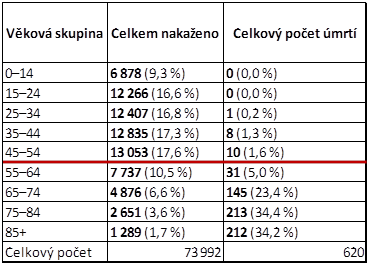
It is necessary to divide the population into 55 years and over 55 years. From the table of deaths we can see that out of 620 people who died in the Czech Republic, 19 died under the age of 55 and 601 over the age of 55. If we exclude seriously ill people from the group under the age of 55, we will significantly reduce % deaths. In other words, patients under the age of 55 and those over the age of 55 will remain in strict quarantine! People under the age of 55 can return to full life without restriction. Thus, a substantial part of the population acquires immunity and at the same time most economically active people immediately return to the work process. Interference in the economy will be much less than with the gradual long-term easing of restrictions. At the same time, the loss of life will be reduced many times compared to the gradual extinction of the population without division. If most people under the age of 55 acquire innate immunity, there is no danger of a pandemic and resections for patients under 55 and over 55 can be lifted.
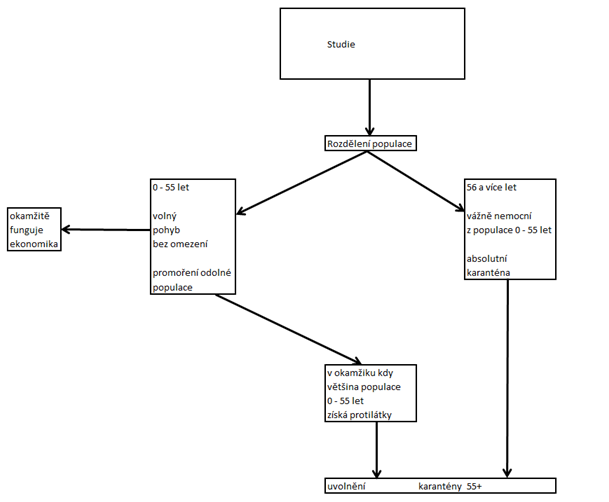
Diagram
Advantages of this variant: less restrictions for people, less immediate costs
Disadvantages: it will certainly result in further loss of life, but especially if you do not know what the Covid-19 virus may cause in the future for people who suffer from it with little or no symptoms, it is a great risk. Another risk is that antibodies in people who have had the disease will not be effective long enough. So far, there has been talk of months, which would not prevent another pandemic in the future.
