


Introduction
This reflection is written as a reflection on the development of humanity from the perspective of its presence with emphasis on its prospects, possibilities and development for the future.
Never in the history of mankind has the situation been as critical for humanity and its future as it is today.
Most people have children and want the best for them. Let's look at the state of our planet, especially life on the planet of civilization, and the state it will be when our children grow up or even when our children's children grow up.
Let's see what the state of our civilization is and what it will be like when our children grow up or even when our children's children grow up.
The planet is changing. From the point of view of human development, it does not matter whether the changes are caused only by man or only by nature or whether it is a partial action of nature and partly the action of people.
Do we have a chance for a quality, free life - healthy under dignified economic and human conditions?
Do we have a chance to live in DEMOCRACY? And what exactly is DEMOCRACY?
What does it mean to live freely? What is freedom?
And what about migration? How to approach it?
Do we need faith and hope? If so, how much?
Who or what is a person?
Do we have a chance to keep our civilization alive so that it survives the next few centuries?
Humanity is multiplying incredibly fast: 1 million more in Africa. People a week. In Asia much more.
This is what the development of the total population in the world looks like:
| YEAR | COUNTRY POPULATION | |
| BC | 8 000 | 1 000 000 |
| BC | 5 500 | 10 000 000 |
| BC | 500 | 100 000 000 |
| nl | 1 800 | 1 000 000 000 |
| nl | 1 925 | 2 000 000 000 |
| nl | 1 960 | 3 000 000 000 |
| nl | 1 975 | 4 000 000 000 |
| nl | 1 986 | 5 000 000 000 |
| nl | 1 999 | 6 000 000 000 |
| nl | 2 011 | 7 000 000 000 |
| nl | 2 050 | 10 000 000 000 |
| nl | 2 150 | 300 000 000 000 |
This is the development of the population in selected countries and in the world in millions in total:
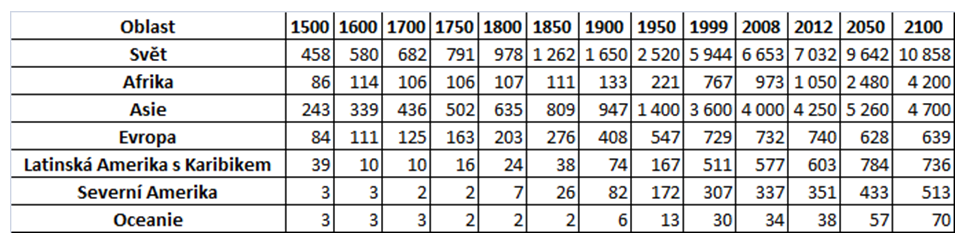
All past cultures and civilizations thought they would be here forever. Egyptian, Roman, Babylonian, etc.
The Roman Empire was great at the time. To give you an idea at the time of its heyday, it was home to over 60,000,000 people, and in the metropolis of Rome, over 1,000,000 people. The Roman army also had more than 400,000 soldiers in peace. At a time when there were an estimated 200,000,000 people living in the country.
The Third Reich was to be 1,000 years old. And how long did it last?
In the USSR they said forever there will be a Soviet Union. Well, he wasn't even 100 years old.
Even the ensembles of civilizations did not last - for example, the American civilizations of the Indians.
And even our planetary civilization today is not at all sure!
And unlike the civilizations mentioned above, she is running out of time! In the days of ancient Rome, 100 years played almost no role, because nothing changed from a global perspective.
But today, every decade, every generation, is at stake. Another 100-200 is the limit of survival or non-survival of humanity!
Can anyone tell who cares what will happen in 30.50.100 or 200 years? Well, if you are 80 and you are not interested in the future of your loved ones, then you really do not have to care.
Of the newborns, some will certainly live to be 90 or 100 years old. They could already live to see the end of human civilization. If not them like their children, their grandchildren almost certainly.
The crucial question is, what about that?
Does humanity even have a chance to overcome the following pitfalls and survive the next 100 or 200 years?
It is certain that the next few hundred years will be crucial for the survival of humanity!
Do we have a chance to create a DEMOCRATIC system - a real not only PARODY of DEMOCRACY?
And what about man as an individual? Its development, faith, perspective, hope?
